
Stand at the foot of Raisina Hill in New Delhi, and there it is, Rashtrapati Bhawan, a structure so commanding and so impossibly grand that it feels less like a building and more like a statement carved in stone. Today, visitors often explore this legacy through the Rashtrapati Bhavan Museum. This space brings its history to life in a way that even a classic Rashtrapati Bhavan photo cannot fully capture. Few places in India carry such layered symbolism: imperial ambition shaped by Indian craft, Western order softened by Asian geometry, and a century-long evolution from a colonial headquarters to a democratic landmark.
Yet for all its political weight, Rashtrapati Bhawan is, at heart, an architectural marvel. It defies strict classification. It is classical but not European, Indian but not traditionally so, modern for its time yet rooted in centuries of subcontinental design. Much of this story unfolds beautifully at the Rashtrapati Bhavan Museum, which offers visitors a guided understanding of this evolution.
This is not just a walk around a residence. It is a walk through one of the most intriguing cultural negotiations ever rendered in sandstone, and the Rashtrapati Bhavan Museum helps interpret these layers through curated exhibits and restored artifacts.

A Palace Born Out of Politics
You must go back to 1911, when King George V declared at the Delhi Durbar that the head office of British India would be moved from Calcutta to Delhi. The British wanted a city that projected power and order. Sir Edwin Lutyens and Herbert Baker were tasked with creating a capital that symbolized permanence. Even this political beginning is documented at the Rashtrapati Bhavan Museum, where early models and drawings help visitors understand the original vision.
Lutyens, initially skeptical of Indian architectural traditions, eventually found himself influenced by local craft and geometry. This shift shaped the building’s identity, a theme further explored in several galleries of the Rashtrapati Bhavan Museum.
The Architecture: A Dialogue in Stone
Rashtrapati Bhawan is an architectural conversation between two worlds. It blends classical European lines with Indian motifs, a duality explained in detail across multiple sections of the Rashtrapati Bhavan Museum.
The Material: Delhi Sandstone
Warm, earthy sandstone softens the classical structure with Indian gentleness. It shifts color through the day, making every angle a new experience. The Rashtrapati Bhavan Museum often highlights these material choices through full-scale displays and tactile installations.
The Plan: 340 Rooms of Geometric Discipline
The building spans roughly 340 rooms across four floors. The plan is defined by:
- Strong axial symmetry
- A massive central dome
- Stately colonnades
A recreation of the original planning model sits at the center of one of the Rashtrapati Bhavan museum halls, giving visitors a scaled view of this enormous layout.
That Dome: The Crown Jewel
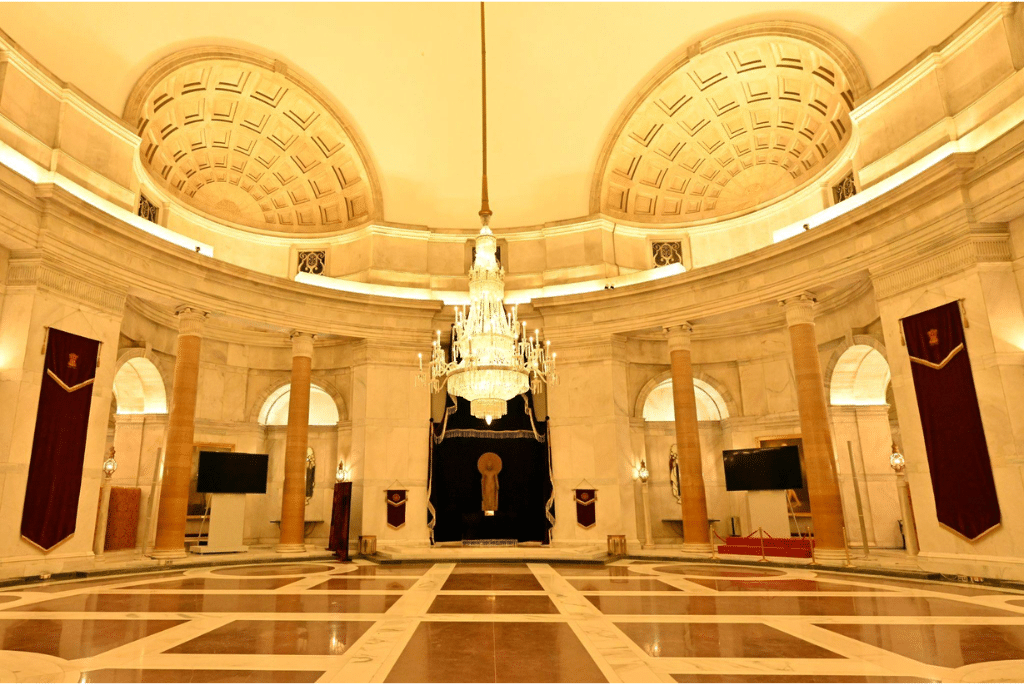
The dome, echoing the Sanchi Stupa, anchors the entire structure. Standing beneath it in the Durbar Hall is an experience that the Rashtrapati Bhavan Museum captures through interactive projections and archival footage. If architecture can express emotion, the dome is where Rashtrapati Bhawan shows its gravitas.
Mughal Meets Modern: Chhatris, Jalis and More
Lutyens and Baker used Indian elements as structural logic rather than surface decoration. The Rashtrapati Bhavan Museum dedicates entire sections to chhatris, jalis, bells, and elephant motifs, showing how design and climate worked together.
Baker’s Touch: The Secretariat Buildings
Herbert Baker’s influence shaped the nearby North and South Blocks. His approach combined classical massing with Indian detail, a story preserved in the Rashtrapati Bhavan Museum archives through letters, correspondence, and architectural sketches.
The Gardens: A Living Textbook of Landscape Design
The Mughal Gardens, now Amrit Udyan, represent a fusion of Mughal geometry, Persian charbagh planning, and English landscape traditions. Visitors often learn about the garden’s evolution through the multimedia wing of the Rashtrapati Bhavan Museum.
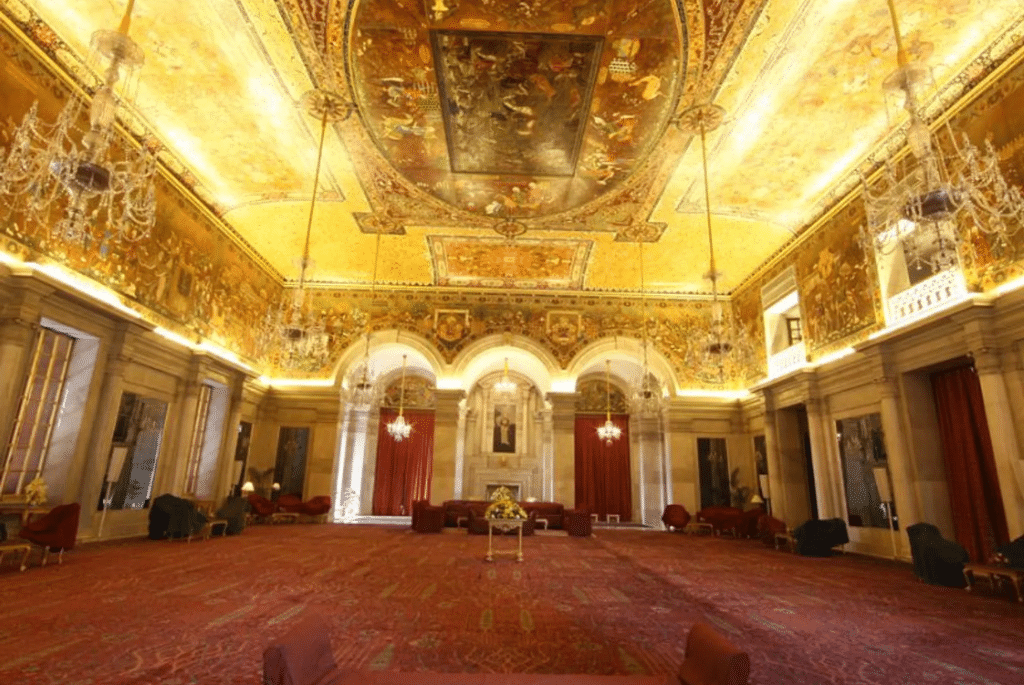
The Interiors: Understated Power
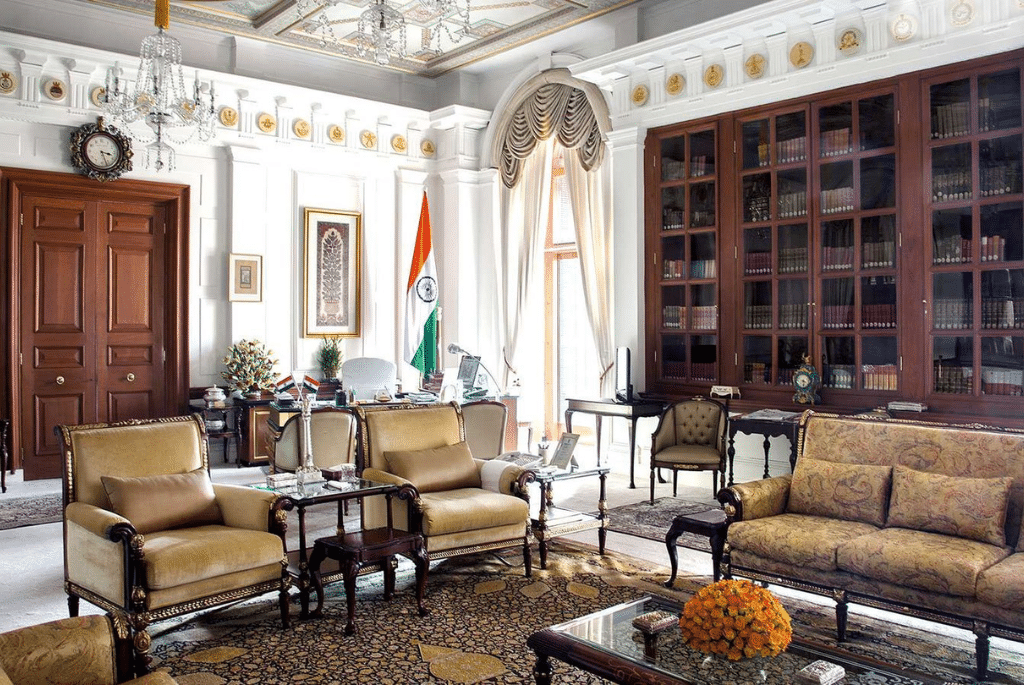
People often expect gold and glitter, but the interior of Rashtrapati Bhavan is defined by restraint and proportion. The museum preserves original furniture, tapestries, and carvings that reflect this understated approach.
Some visitors are curious about unique design features, such as the bathroom at Rashtrapati Bhavan, which is displayed in the museum’s heritage restoration wing.
Key spaces include:
- The Durbar Hall
- The Ashoka Hall
- The Banquet Hall
- The Library
The Rashtrapati Bhavan Museum recreates these interiors through scaled models and immersive light walkthroughs.
Also read: Inside Kim Kardashian House: Minimalist Luxury Meets Timeless Elegance
From Viceroy’s House to Rashtrapati Bhawan
On 26 January 1950, the Viceroy’s House became the home of the President of India. The name, role, and meaning changed. This transformation is one of the core narratives at the Rashtrapati Bhavan Museum, where visitors can trace how a colonial monument became a democratic icon.
Rashtrapati Bhawan’s Place in Indian Modernity
The building influenced post-Independence design across India. The Rashtrapati Bhavan Museum showcases this impact through architectural photographs and comparative diagrams.
Highlights Visitors Shouldn’t Miss
If you explore its public circuits, here is what to look out for:
- The Marble Hall
- Amrit Udyan
- The Durbar Hall
- The Forecourt
- The North and South Drawing Rooms
- The Ashoka Hall Ceiling
Each of these spaces has dedicated coverage in the Rashtrapati Bhavan Museum, with VR experiences adding depth to the visit.
The Design Philosophy: Order With Soul
Rashtrapati Bhawan balances geometry with emotion. Indian motifs soften classical discipline. The Rashtrapati Bhavan Museum brings this philosophy to life through storytelling panels and architectural installations.
Rashtrapati Bhawan in the 21st Century
Today, the building operates as:
- The President’s residence
- A ceremonial venue
- A cultural space
- A national symbol
- And importantly, the Rashtrapati Bhavan Museum, which has become one of the most visited heritage museums in the capital
Digitization, accessibility upgrades, and expanded museum galleries ensure the legacy remains relevant. The Rashtrapati Bhavan Museum is central to preserving and presenting this heritage.
Why Rashtrapati Bhawan Still Matters
- Because it holds stories.
- Because it holds contradictions.
- Because it holds beauty.
Much of this understanding is now shaped by the Rashtrapati Bhavan Museum, which allows the public to engage with what was once a closed world. It proves that even the grandest architecture can evolve while staying rooted in integrity.
Rashtrapati Bhawan is not just an address on Raisina Hill. It is a conversation between eras, cultures, materials, and identities. And through the Rashtrapati Bhavan Museum, that conversation continues to reach new generations.
For bookings and further details, please visit the official Rashtrapati Bhavan website